Growth factors are the most expensive category in most medical skincare lines and the least well explained. Patients are frequently told a serum contains them, rarely told what they are, and almost never told what the evidence actually supports.
Here is a plain account of what they do, what they do not do, and how to judge whether one belongs in your regimen.
What growth factors actually are
Growth factors are proteins your body already produces. They are signaling molecules, meaning their job is to instruct cells rather than to act directly on tissue.
In skin, they coordinate wound healing and tissue maintenance. When skin is injured, growth factors tell fibroblasts to produce collagen and elastin, direct new cell growth, and manage the repair sequence. Their production declines with age, which is part of why older skin repairs more slowly and produces less collagen.
This is a fundamentally different mechanism from most actives. A retinoid changes how skin cells behave by binding receptors. An acid removes surface cells. A growth factor delivers an instruction and lets the cell carry it out.
Where the growth factors in skincare come from
Three broad sources, and the distinction matters.
Human fibroblast conditioned media. Human skin cells are cultured in a laboratory and the nutrient medium they secrete proteins into is collected and processed. This produces a complex mixture of growth factors, cytokines, and matrix proteins in roughly the proportions skin produces naturally. SkinMedica’s TNS products use this approach.
Plant-derived and synthetic. Botanical extracts or laboratory-synthesized peptides designed to mimic growth factor activity. Generally simpler and less expensive, with correspondingly less evidence behind them.
Other biological sources, including products marketed as containing exosomes or stem cell derivatives. This category deserves caution: the FDA has issued warnings about unapproved products in this space, and marketing frequently outpaces evidence considerably.
What the evidence supports
Growth factor products are cosmetic formulations rather than prescription medications, so the evidence base is manufacturer-sponsored rather than the kind of independent trial data that supports, say, tretinoin. That is worth knowing when reading any claim.
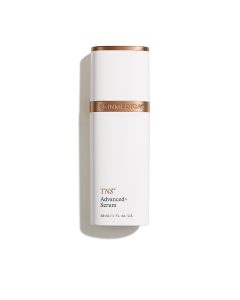
SkinMedica reports, from its own clinical studies, that TNS Advanced+ Serum produces visible improvement beginning around two weeks, with results continuing to improve through twenty-four weeks of use, and describes it as addressing coarse wrinkles, fine lines, skin tone, texture, and sagging. Those are the manufacturer’s findings from the manufacturer’s trials, and they should be read as such rather than as independent verification.
What can be said more generally is that the mechanism is sound, that this category has more supporting data than most cosmetic ingredients, and that the effect is gradual and cumulative rather than dramatic.
Growth factors, retinoids, and peptides compared
Retinoids have the strongest independent evidence for collagen stimulation and are the reference standard. They also irritate, require a careful introduction, and are unsuitable in pregnancy.
Growth factors work by signaling rather than by forcing turnover, which makes them notably well tolerated. Skin that cannot cope with a retinoid can usually cope with a growth factor serum.
Peptides are shorter amino acid chains, generally the gentlest of the three and generally the least potent.
These are not mutually exclusive. A common and sensible pairing is a growth factor serum in the morning and a retinoid at night, which delivers two different collagen-supporting mechanisms without stacking two irritants.
Who benefits most
- Patients whose skin cannot tolerate retinoids but who want collagen support.
- Post-procedure recovery. Because growth factors are central to wound healing, they are a logical fit after microneedling, radiofrequency microneedling, peels, and resurfacing, once the barrier has recovered enough for actives.
- Patients in their thirties and beyond, as natural production declines.
- Anyone already using a retinoid who wants a complementary daytime mechanism.
The honest limitations
Growth factors will not do what a neurotoxin does. Expression lines come from muscle movement and no serum addresses that.
They will not replace volume. They will not resurface the way a laser resurfaces. And molecule size means topical penetration is genuinely limited, which is a real constraint on any large protein applied to intact skin.
They are also slow. Judging one at four weeks is judging nothing. This is a category evaluated at three to six months.
The question patients ask most, and it is a fair one
If growth factors tell cells to grow, could they encourage abnormal cell growth?
The theoretical concern is reasonable and worth taking seriously rather than dismissing. In practice, these are large molecules applied to intact skin, where penetration into living tissue is limited, and they signal the normal repair processes skin already runs continuously. There is no evidence that topical growth factor skincare increases cancer risk.
That said, patients with active cancer, those in treatment, and those with a history of skin cancer should raise it with their oncologist or dermatologist before starting. A physician-led practice should be having that conversation rather than avoiding it.
How to use them
Apply to clean, dry skin before heavier products, since a serum cannot pass through a moisturizer already in place. Morning suits most people, particularly when a retinoid occupies the evening.
Give it a minute to absorb, then moisturize, then apply broad-spectrum sunscreen. Consistency matters more than quantity here, and the products are expensive enough that using them sporadically wastes them.
Why they cost what they cost
Culturing human cells, collecting and processing conditioned media, and stabilizing large proteins in a formulation that keeps them viable is genuinely expensive manufacturing. It is not primarily a branding premium.
Whether that cost is justified for you depends on what you are treating and what else is in your regimen. For someone not yet using sunscreen daily or not yet on a retinoid, a growth factor serum is not the first purchase to make. For someone already doing both consistently, it is a reasonable next step.
Where a physician helps
Dr. Kristin Dean, MD, a physician board-certified by the American Board of Family Medicine, assesses your skin and builds a regimen around it, which includes telling you when a product is not the right use of your money. Glomi Wellness Lab is a concierge practice, so that assessment happens at your home or office across San Diego County, including Encinitas, La Jolla, Del Mar, Solana Beach, Rancho Santa Fe, and Carmel Valley.
The TNS range is available through the Glomi online store, including TNS Recovery Complex and TNS Eye Repair. See the full approach on the Glomi Skincare page, and read how to layer your skincare for where a growth factor serum belongs in the order.
Frequently asked questions
What is the difference between growth factors and peptides?
Growth factors are complete proteins that signal cells to perform repair processes. Peptides are shorter amino acid chains, generally gentler and generally less potent. Many products contain both.
Can I use a growth factor serum with retinol?
Yes, and it is a sensible combination. Most people use the growth factor serum in the morning and the retinoid at night, which avoids stacking irritation while providing two mechanisms.
How long before I see results?
This is a slow category. Early changes in texture and brightness may appear within weeks, but meaningful improvement is assessed at three to six months of consistent use. Individual results vary.
Are growth factors safe in pregnancy?
There is limited safety data on cosmetic growth factor products in pregnancy, as there is for most cosmetic ingredients. Discuss any regimen with your obstetrician, who may prefer you simplify.
Is a plant-derived growth factor as good as a human one?
They are different molecules. Human-derived conditioned media more closely matches what skin produces, and carries more supporting data. Plant-derived options are generally less expensive with correspondingly less evidence.
Should I use one after microneedling?
Frequently yes, but not immediately. Wait until the barrier has recovered enough for actives, generally around seventy-two hours, and follow the specific guidance you were given.
Find out whether it belongs in your regimen
Call Glomi Wellness Lab at (442) 222-8485 or email scheduling@glomiwellnesslab.com to arrange a complimentary consultation anywhere in San Diego County.